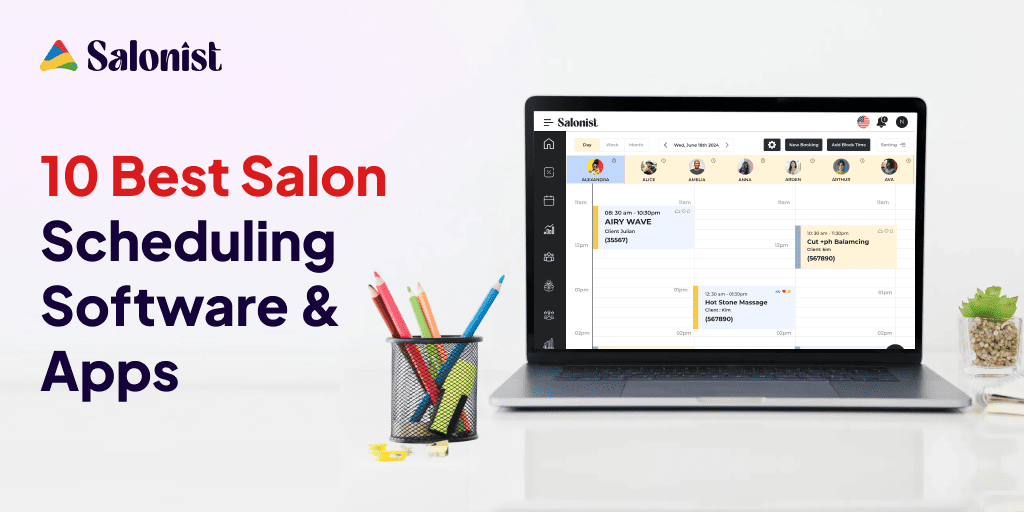
Choosing between the best salon apps on the market has become genuinely harder over the last two years, not easier. Prices have moved, several platforms have changed their pricing models outright, and the gap between a $10 tool and a $375 tool is no longer obvious from the marketing pages.
This comparison covers ten platforms across every price tier, with real pricing, honest drawbacks, and a clear recommendation for each type of business. If you run a single chair, a five-stylist salon or a multi-location group, the right answer is different — and this guide says which is which rather than declaring one universal winner.
A note on who wrote this: Salonist is our own product and it appears on this list. We’ve included its limitations alongside everyone else’s, and we’ve named the situations where a competitor is the better choice. Judge the list on whether that’s true.
Salon Apps vs Salon Software: What’s the Difference?
The two terms get used interchangeably, and mostly that’s fine — but the distinction matters when you’re choosing.
Salon software traditionally means the back-office system: the desktop dashboard your front desk runs the day from, handling scheduling, POS, inventory, payroll and reporting.
Salon apps means the mobile-first layer. That usually splits in two directions:
- Staff apps — a stylist checking their calendar, taking a payment or messaging a client from their phone
- Client apps — where customers book, reschedule, pay and store a card
Most modern platforms are both. But they lean. GlossGenius and Booksy are app-first, built around a phone screen. Zenoti and Mindbody are software-first, built around a workstation. That lean tells you a lot about who each product is really for.
The practical question to ask: will my team mostly be at a desk, or on the floor with a phone in their pocket? The best salon apps for a mobile booth renter are not the best choice for a 20-chair salon with a dedicated receptionist.
How We Chose the Best Salon Apps
Five criteria, weighted toward what actually causes salons to switch platforms.
Ease of use
Staff turnover in beauty is high, and every hour of training is an hour not earning. A clear calendar, obvious checkout flow and simple menu structure matter more than feature count. Platforms that need a week of onboarding lose points.
Scheduling depth
Beauty scheduling has quirks that generic booking tools handle badly: processing time on a colour service, double-booking a stylist during a 40-minute development, resource booking for a treatment room, staggered service durations per staff member. Any of the best salon apps should handle these natively.
Data security and compliance
Client records include contact details, treatment history and payment data. Look for encryption at rest, role-based staff permissions, and — if you offer any medical-adjacent services — HIPAA capability. Salonist maintains PCI DSS, SOC 2, HIPAA, GDPR and CCPA compliance; not every platform on this list publishes the same.
Pricing transparency
This became a real differentiator in 2026. Several platforms advertise a low headline price that bears little relation to the bill. We’ve flagged per-staff charges, processing fees and marketplace commissions for every entry, because those are where the money actually goes.
Verified reviews
We weighted Capterra, G2 and Software Advice reviews from businesses of comparable size, and discounted reviews on vendor-owned properties. Worth knowing: several widely cited “best salon software” review sites are owned by platforms on this list. Read accordingly — including this one.
The 10 Best Salon Apps Compared at a Glance
| App | Starting Price | Free Tier | Best For |
|---|---|---|---|
| Salonist | From $79/month | Free trial, no free plan | Multi-location salons and spas with salon marketplace |
| Vagaro | From $30/mo per calendar, +$10 each | 30-day trial | Marketplace exposure on a budget |
| Fresha | $19.95/mo solo; $14.95 per team member | No — free plan ended 2025 | New client acquisition |
| GlossGenius | From $28/mo (Gold $56, Platinum $168) | Free trial | Solo stylists and booth renters |
| Mangomint | From $165/mo (up to $375) | Free trial | Design-led salons, 2–10 staff |
| Booksy | From $29.99/mo, +$20 per team member | Free trial | Barbershops and solo pros |
| Mindbody | From $99/mo per location; salon tiers ~$159 | No | Wellness and fitness crossover |
| Zenoti | Custom quote; third parties cite ~$225/mo+ | No | Enterprise chains, 3+ locations |
| SimplyBook.me | From $9.90/mo | Yes, limited free plan | Tight budgets, heavy customisation |
| Timely | From ~$26–29/mo (~$11 per user, Starter) | 14-day trial, no free plan | Reporting and business insights |
Pricing verified July 2026. Excludes payment processing, SMS and add-on fees. Verify current rates with each vendor before purchasing.
Watch the processing fees, not just the subscription. Vagaro charges roughly 2.75% + $0.15 on in-person card payments. GlossGenius charges a flat 2.6%. Fresha runs around 2.19–2.79% + $0.20 and takes a 20% commission (minimum $6) on any new client who finds you through its marketplace. On a $10,000 month, those percentages dwarf the subscription line. Compare total cost at your actual revenue, not the headline price.
Full details on Salonist tiers are on the Salonist pricing page.
Reviews of the 10 Best Salon Apps
#1. Salonist — Best for multi-location salons and spas
Salonist is an all-in-one platform covering booking, POS, inventory, staff management, marketing and reporting, with a drag-and-drop calendar and multi-branch management built in rather than bolted on.
Pros
- Genuinely all-in-one — no add-on fees for marketing, forms or memberships
- Strong multi-location support: cross-branch reporting, centralised inventory
- Compliance credentials most competitors at this price don’t publish (PCI DSS, SOC 2, HIPAA, GDPR, CCPA)
- Flat $10 per additional staff member, capped — costs stop climbing past 14 staff
- Up to 25% discount on annual billing
Cons
- No free plan. If your budget is genuinely $0, SimplyBook.me or Square is the honest answer.
- Smaller third-party integration library than Vagaro or Mindbody
- Lower brand recognition in the US than Fresha or Booksy, which matters if you want marketplace discovery
- Reviewers consistently ask for more report customisation
- Entry price is higher than Vagaro or Booksy — you’re paying for breadth you may not need at one chair
Best for: salons and spas with 3+ staff or more than one location, especially those wanting one system rather than a stack.
Explore the online booking system and salon POS individually, or see side-by-side comparisons against specific competitors.
#2. Vagaro — Best value for marketplace reach
Vagaro takes a kitchen-sink approach: an enormous feature set at a low base price, with modules sold separately.
Pros
- Cheapest credible entry point among full-featured platforms
- Free Vagaro Marketplace listing with no per-booking commission — a real advantage over Fresha
- No long-term contracts
- 24/7 support included at base tier
Cons
- Priced per “bookable calendar” — every stylist adds $10/month
- Essential features are add-ons: SMS marketing ($20), branded app ($100), payroll (~$34 + $5/employee)
- A three-chair salon realistically lands at $70–$150/month before processing
- The marketplace lists your competitors alongside you
- Interface feels dated and takes longer to master than lighter apps
Best for: independent single-location salons that want maximum features per dollar and will actually use the marketplace.
#3. Fresha — Best for new client acquisition (but read the pricing change)
Important: Fresha is no longer free. It moved to paid subscriptions in 2025, and a lot of comparison content still hasn’t caught up.
Pros
- Large consumer marketplace with genuine discovery value
- Still among the cheapest per-seat options
- Strong client-facing app with wide brand recognition
- Good multi-location permissions
Cons
- The free plan is gone — $19.95/month solo, $14.95 per team member
- 20% commission (minimum $6) on every new marketplace client. If you also run paid ads, you pay for acquisition twice.
- Only 20 free messages per month; a salon sending confirmation plus reminder crosses that at roughly 10 appointments
- Pricing is geo-served, so quoted figures vary by country
- Payment processing locked to Fresha Payments — you can’t bring your own negotiated rate
Best for: businesses where marketplace discovery genuinely drives growth. If you already have a full book, you’re paying commission on clients you’d have won anyway.
For a deeper breakdown, see our guide to Fresha alternatives and competitors.
#4. GlossGenius — Best for solo stylists
Design-led and unapologetically built for one person. The booking page is the prettiest in the category.
Pros
- Best-looking client-facing booking site of any platform here
- Flat 2.6% processing with no per-transaction fee
- No add-on fees on Standard
- Fast setup — genuinely usable within an hour
Cons
- Waitlists, forms, waivers and Reserve with Google are gated behind Gold ($56)
- Add one staff member and you’re effectively forced up a tier
- At $5,000 monthly card revenue the 2.6% fee adds ~$130 — the subscription is the small part
- Thin multi-location and inventory capability
- US-focused; limited use elsewhere
Best for: solo stylists, booth renters, estheticians and lash techs who care about brand presentation.
#5. Mangomint — Best for design-led boutique salons
Polished, opinionated, and openly not for solos — Mangomint says so itself.
Pros
- Excellent interface and workflow design
- Flat-rate tiers with payroll, memberships and marketing automation included
- Strong automation that reduces front-desk workload
Cons
- $165/month floor is the highest entry price here bar enterprise tools
- Explicitly wrong for solo practitioners
- No clinical records or consent capture — a gap for med spas
- Only pays off if you actually use payroll and marketing automation
Best for: salons with 2–10 service professionals wanting a premium all-in-one without managing add-ons.
#6. Booksy — Best for barbershops
Marketplace-first with a single all-inclusive plan and no feature gating.
Pros
- Every feature included at one price — no tier gating
- Strong consumer marketplace, particularly dominant in barbering
- Simple, efficient interface built for speed over polish
- Complimentary client-book transfer when switching
Cons
- $20 per additional team member adds up faster than Vagaro’s $10
- Less suited to spas and treatment-room businesses
- Reporting is shallower than Timely or Salonist
- Interface prioritises function over presentation
Best for: barbershops and solo beauty professionals who want marketplace visibility with predictable pricing.
#7. Mindbody — Best for wellness and fitness crossover
The dominant wellness platform, extended into beauty rather than built for it.
Pros
- Unmatched for businesses combining classes, memberships and appointments
- Very large consumer marketplace
- Mature membership and package management
Cons
- Not optimised for beauty: no colour formula management, limited backbar inventory
- POS isn’t built for fast salon checkout
- Pricing escalates sharply; key modules sit behind higher tiers
- Overcomplicated for a traditional hair or nail salon
- No free tier and entry pricing starts around $99/location
Best for: spas with wellness classes, salons attached to gyms, holistic studios.
#8. Zenoti — Best for enterprise chains
The deepest enterprise feature set in the category, priced accordingly.
Pros
- Genuine multi-country and franchise management
- Complex reporting, room and resource booking for large spas
- AI capability at enterprise tier, including AI receptionist
- Built for scale rather than retrofitted
Cons
- No published pricing — custom quote, long sales cycle
- Implementation is heavy; not a weekend setup
- Unsuitable for budget-sensitive single-location salons
- You pay for depth you won’t use below roughly 3 locations or 10 staff
Best for: chains and franchises with 3+ locations.
#9. SimplyBook.me — Best on a tight budget
The most flexible low-cost option, with a genuine free plan.
Pros
- From $9.90/month — cheapest paid tier here
- Real free plan, not just a trial
- Highly customisable with a large module library
- Books through Facebook and Instagram directly
Cons
- Generic rather than beauty-specific — no colour formulas, no processing time
- Customisation means configuration work; setup takes longer
- Free and entry plans cap bookings
- Reporting and inventory are basic
- No meaningful consumer marketplace
Best for: very small studios on tight budgets, or businesses with unusual booking requirements.
#10. Timely — Best for reporting and insights
Purpose-built for hair and beauty with unusually good business analytics for the price.
Pros
- Genuinely useful reporting at an accessible price point
- Minimise Gaps feature packs the schedule intelligently
- Clean, quick interface
- No fixed contracts
Cons
- No free plan — 14-day trial only
- Per-bookable-staff pricing, charged the same for part-timers
- Per-message SMS charges on top
- Pricing varies noticeably by region, so quoted figures are unreliable
- Not built for 15+ staff or clinical compliance
Best for: small salons and studios that want to actually understand their numbers.
Best Salon Apps for Solo Stylists vs Multi-Location
The single most common mistake is buying for the business you want rather than the one you run.
If you’re solo or renting a chair, you need a personal calendar, a booking link, mobile payments and client messaging. You do not need payroll, multi-branch inventory or franchise reporting. GlossGenius, Booksy or SimplyBook.me all fit. Paying $165/month for Mangomint at one chair is buying capability you’ll never open.
One thing to check first: if you rent a chair inside a larger salon, ask whether their existing system gives you an individual stylist login. Plenty of stylists pay for a second platform they didn’t need.
If you run 3–15 staff at one location, pricing structure matters more than headline price. Per-staff models scale linearly; bundled models have a base fee plus a smaller marginal cost. Run the maths at your current team size and your expected size in twelve months. Vagaro, Salonist, Timely and Mangomint all compete here for different reasons.
If you run multiple locations, you need cross-location booking, consolidated reporting and centralised inventory. This is where lighter apps break down. Salonist, Zenoti and Mindbody are the realistic candidates. At this scale the platform fee is usually less than 1.5% of revenue — far less than the cost of outgrowing your system mid-year.
Vertical fit matters too. A hair salon has different scheduling needs from a med spa or a tattoo studio, and several of the best salon apps here handle some verticals notably better than others.
What to Check Before You Switch
Nobody covers this, and it’s where migrations go wrong.
- Client data export. Can you get your client list, appointment history and notes out in a usable format? Ask specifically whether treatment notes and colour formulas export, not just names and numbers. Some platforms export contacts only.
- Who does the import. Booksy and Mangomint offer assisted transfers. Others hand you a CSV template. Assisted migration is worth real money.
- Future bookings. Appointments already on the calendar are the hardest thing to move. Confirm whether they transfer or whether you re-enter them manually.
- Contract and notice period. Check for annual lock-ins and how much notice cancellation requires. Some platforms bill a full year if you leave mid-term.
- Payment processing entanglement. If your current platform processes your payments, switching means changing processor too — new terminal, new payout schedule, possibly a new rate. Budget a fortnight of overlap.
- Card-on-file portability. Stored client cards usually do not transfer. Plan to re-collect them.
- Run both in parallel. Two to four weeks of overlap costs one extra month’s subscription and prevents a bad week from becoming a bad quarter.
The Bottom Line
In conclusion, consider your salon’s needs and budget. Carefully do this before choosing the best salon apps or software. Each of the options presented in this blog has its unique strengths & features. But, if you are still unsure about which one to choose, we recommend giving Salonist a try. It automates many salon tasks. This saves lots of time and boosts efficiency.
Frequently Asked Questions (FAQs)
What does salon software mean?
Salon software is a management platform that handles the operational side of a beauty business — appointment scheduling, client records, staff rotas, inventory, payments and reporting — in one system. The term covers both desktop dashboards used by front-desk staff and mobile apps used by stylists and clients. Most of the best salon apps available today are cloud-based, meaning you access them from any device without installing anything.
What is the best salon software?
There is no single best answer, because the right choice depends on your size and setup. Solo stylists usually do best with a lightweight mobile-first app; multi-location salons need multi-branch reporting and inventory that lightweight apps don’t offer. Salonist, Vagaro, Fresha and GlossGenius all rank among the best salon apps for different reasons — compare them on pricing, free tier and multi-location support rather than looking for a universal winner.
What software do salons use?
Most salons use a cloud-based booking and management platform. The most widely adopted options include Salonist, Vagaro, Fresha, Booksy, Mindbody and Zenoti. Larger chains tend toward Zenoti or Mindbody for enterprise reporting, while independents lean toward Fresha or Booksy for their client-facing marketplaces. Smaller studios often pick whichever of the best salon apps has the simplest interface and lowest monthly cost.
What software do stylists use?
Individual stylists — including booth renters and chair-rental professionals — typically use different tools than salon owners. They need personal calendars, direct client messaging, mobile payments and their own booking link, not staff management or multi-branch inventory. GlossGenius, Fresha and Booksy are common picks. If you rent a chair inside a larger salon, check whether the salon’s existing system already gives you an individual stylist login before paying for a second tool.
What is the best software to manage all salon operations?
For genuinely all-in-one operations you need scheduling, POS, inventory, staff management, marketing and reporting in a single system rather than several tools stitched together. Salonist, Zenoti and Mindbody are built for this breadth. Lighter apps handle bookings well but leave gaps in inventory and multi-location reporting. If you currently run separate tools for booking and payments, consolidating is usually where the biggest time saving comes from.
How much is Salonist salon software?
Fresha operates on a freemium model — the core booking and calendar functionality is free, with revenue coming from commission on new marketplace clients plus paid add-ons for marketing and integrated payments. That makes it inexpensive to start but the commission structure means costs scale with the bookings it brings you. Verify current rates on Fresha’s pricing page before committing, and see our full breakdown of Fresha alternatives and competitors for how it compares.
Increasing salon customers reviews is a great way to build trust and improve your online presence. These reviews act like Read more

Starting a beauty business can be both exciting and challenging. While you may have a passion for hair, makeup, or Read more
The beauty and wellness industry has seen a significant upswing in recent years, with an increasing focus on self-care and Read more
Rosy Salon Software, a cloud-based platform, serves as a bridge between beauty professionals and their customers. It offers a solution Read more