The UAE’s beauty and wellness market is one of the fastest-growing in the world, and the beauty industry trends 2026 data shows exactly why: a large, high-income, culturally diverse population that treats grooming as a daily practice rather than an occasional treat. Dubai and Abu Dhabi have become world-class destinations for premium beauty services, with thousands of salons, spas, and aesthetic clinics competing for a client base that spans over 200 nationalities. This report breaks down Salonist’s 2026 findings on what’s actually being booked, how much it’s worth, and what salon owners need to know to keep up.
Executive Summary to Beauty Trends Report
The UAE’s beauty industry growth is being driven by three forces: digital booking adoption, demand for premium/personalized services, and rising disposable income. With over 15,000 licensed beauty salons and spas in Dubai alone, competition is intense — and consumer expectations have shifted accordingly. Clients no longer want just a haircut; they expect a tailored experience backed by technology, from online booking to personalized service recommendations.
Market Growth Insights
The rise of salon management software with instant online booking has made accessing services dramatically easier for UAE consumers. Salonist’s own platform data — appointment patterns, service groupings, and client behavior across salons in the region — shows hair services still commanding the largest share of spend, nail services generating the highest visit frequency, and skincare as the fastest-growing category.
The top service categories driving bookings in the UAE right now:
- Hair Services
- Nail Services
- Skin Care & Facials
- Lash & Brow Services
- Hair Removal Services
- Men’s Grooming Services
- Scalp & General Wellness Treatments
Across all of these, one shift stands out: traditional beauty services are becoming experience-based, technology-enabled, wellness-focused offerings — not standalone transactions.
Salon Services UAE 2026: Year in Review
The Beauty Trends Report summarizes the advancements in salon services for 2026.
| Total Valuation | $3.49 billion |
| Expected Growth (CAGR) | 6.14% |
| Dubai & Abu Dhabi’s National Share | 70% |
Source: Fortune Business Insights, Salon Service Market Report
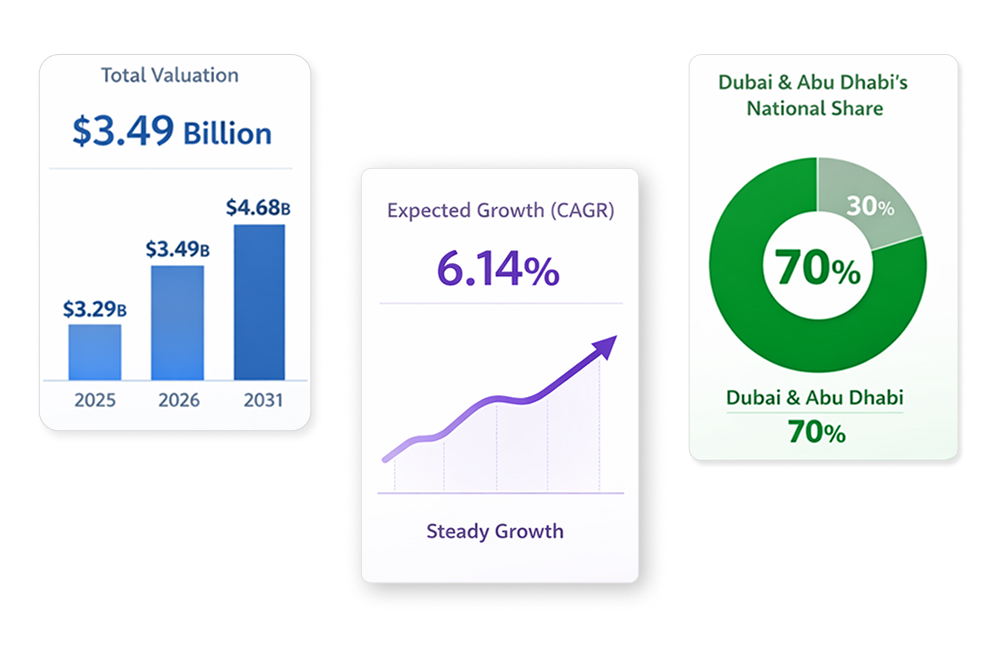
By 2026, the UAE’s beauty and cosmetics sector is valued at $3.49 billion, growing at a compound annual rate of 6.14%. Salons in Dubai and Abu Dhabi alone now account for over 70% of the national market share, fueled by a wealthy, well-connected population and a fast-expanding tourism sector.
This period is defined by what the report calls “Precision Pampering” — clients no longer want generic treatments; they want targeted, specialist, machine-supported services. Hair care still generates the most revenue overall, but “Clinical Skincare” and men’s “Express Grooming” are the fastest-growing categories.
Market Overview 2026
The UAE’s beauty and wellness ecosystem now spans luxury retail, tourism, and global beauty brands — a diverse mix that draws residents, tourists, and expats with very different grooming preferences. With 97% smartphone penetration, online booking platforms like Salonist — which already accounts for roughly 65% of total salon booking volume — have shifted from “convenient” to essential infrastructure.
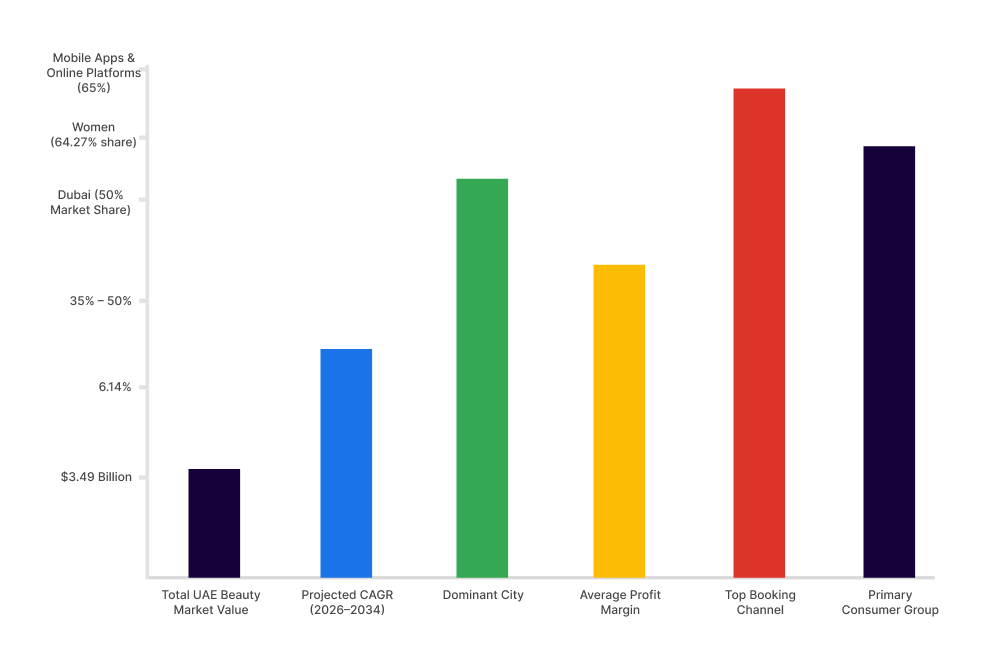
The Beauty Trends Report provides a snapshot of market indicators for beauty services.
| Indicator | Numbers |
|---|---|
| Total UAE Beauty Market Value | $3.49 Billion |
| Projected CAGR (2026–2034) | 6.14% |
| Dominant City | Dubai (50% Market Share) |
| Average Profit Margin | 35% – 50% |
| Top Booking Channel | Mobile Apps & Online Platforms (65%) |
| Primary Consumer Group | Women (64.27% share) |
Beauty Trends UAE 2026: What’s Hot
Multicultural Client Base
The UAE’s 200+ nationalities each bring distinct service preferences, and that diversity has directly shaped how hair salons and skincare clinics build their menus:
- Arab clientele lean toward hair coloring and facial treatments
- South Asian clientele request threading and hair treatments
- Westerners favor skincare treatments like HydraFacials
- Southeast Asian clients mostly book manicures, nail art, and eyelash extensions
This has pushed salons toward genuinely differentiated service menus by hair texture, skin type, and cultural beauty standards — rather than a one-size-fits-all approach.
Beauty Expenditure in Dubai
Beauty spending in the UAE runs well above international averages. Surveyed consumers in Dubai spend an average of AED 847 per month on beauty treatments and services — reflecting the region’s premium, luxury-first positioning. Bridal makeup packages are a growing driver of this spend, alongside high social media influence that encourages regular repeat visits and trial of new treatments.
Quick Digital Change
Technology has reshaped both how salons operate and how clients book:
- 72% of salons now use technology for appointment booking
- 82%+ of online bookings happen via mobile devices
The main gains: better appointment management, fewer missed appointments through automated reminders, and personalized service recommendations built from client history. Salonist enables salons to analyze booking trends and adjust pricing strategy based on which services actually perform.
Experience-Driven Beauty in 2026
Clients now want more than a haircut or manicure — they want beauty, wellness, and relaxation combined into one visit. Newer service additions gaining traction include:
- Scalp Therapy Services
- Full-Service Facials
- Hair Repair Treatments
- Wellness-Oriented Massages
As self-care and mental wellbeing stay top of mind for consumers, demand for these combined-experience services keeps climbing.
Most Booked Salon Services in Dubai and the UAE
I. Hair Care: The Current Industry Leader
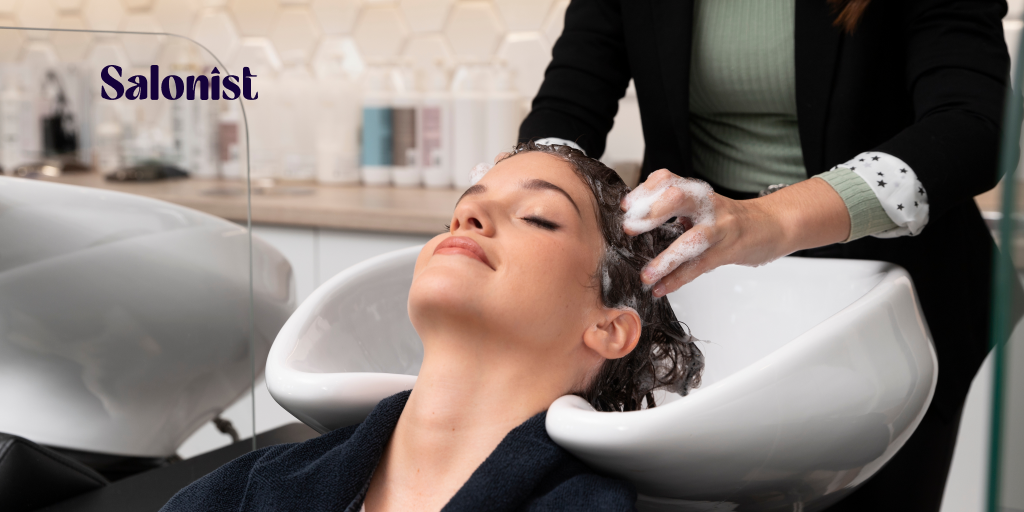
Hair care represents around 76% of all salon transactions in the UAE, and has moved well beyond basic haircutting into advanced restoration services — a shift that’s fueling steady demand for hair salon software built specifically around retail attach and repeat-visit tracking.
- Most frequently booked: Balayage and “Liquid Hair” glossing
- Popular trend: 45% of clients now request organic/ammonia-free hair coloring
- Up-and-coming: Scalp facials and detoxification services
Why scalp services are rising: Water quality and humidity levels in the UAE have driven a sharp increase in bookings focused on scalp health over the past year. Keratin and protein Botox treatments remain Gulf staples for frizz management, particularly among expatriate clients.
Hair salon booking trends in Dubai most commonly include:
- Haircuts and styling
- Hair colouring
- Balayage
- Hair treatments
- Blow-dry services
- Keratin and smoothing treatments
Hair colouring and balayage in particular account for a significant share of global salon colour service revenue.
Why hair services dominate:
- High visual impact — transformations are widely shared on Instagram and TikTok
- Regular maintenance cycles — touch-ups every 4–8 weeks
- Specialized expertise — most treatments can’t be replicated at home
Trending hair treatments in 2026 include Hair Botox, Olaplex strengthening treatments, bond repair therapies, and organic hair care — alongside rising demand for scalp microbiome health as clients become more aware of long-term hair health.
II. Professional Skincare: “Skin-tellectual” Culture
2026 marks the end of the generic “relaxing” facial. Clients now expect measurable results from Medical-Grade Esthetics (MGE), which has made medical spa and aesthetic clinic software one of the fastest-growing categories for salon operators to add.
-
- Haircuts and styling
- Hair colouring
- Balayage
- Hair treatments
- Blow-dry services
- Keratin and smoothing treatments
Most Booked Salon Services in Dubai and the UAE
I. Hair Care: The Current Industry Leader
Hair care represents around 76% of all salon transactions in the UAE, and has moved well beyond basic haircutting into advanced restoration services — a shift that’s fueling steady demand for hair salon software built specifically around retail attach and repeat-visit tracking
- Most frequently booked: Balayage and “Liquid Hair” glossing
- Popular trend: 45% of clients now request organic/ammonia-free hair coloring
- Up-and-coming: Scalp facials and detoxification services
Why scalp services are rising: Water quality and humidity levels in the UAE have driven a sharp increase in bookings focused on scalp health over the past year. Keratin and protein Botox treatments remain Gulf staples for frizz management, particularly among expatriate clients.
Hair salon booking trends in Dubai most commonly include:
- Haircuts and styling
- Hair colouring
- Balayage
- Hair treatments
- Blow-dry services
- Keratin and smoothing treatments
Hair colouring and balayage in particular account for a significant share of global salon colour service revenue.
Why hair services dominate:
- High visual impact — transformations are widely shared on Instagram and TikTok
- Regular maintenance cycles — touch-ups every 4–8 weeks
- Specialized expertise — most treatments can’t be replicated at home
Trending hair treatments in 2026 include Hair Botox, Olaplex strengthening treatments, bond repair therapies, and organic hair care — alongside rising demand for scalp microbiome health as clients become more aware of long-term hair health.
II. Professional Skincare: “Skin-tellectual” Culture
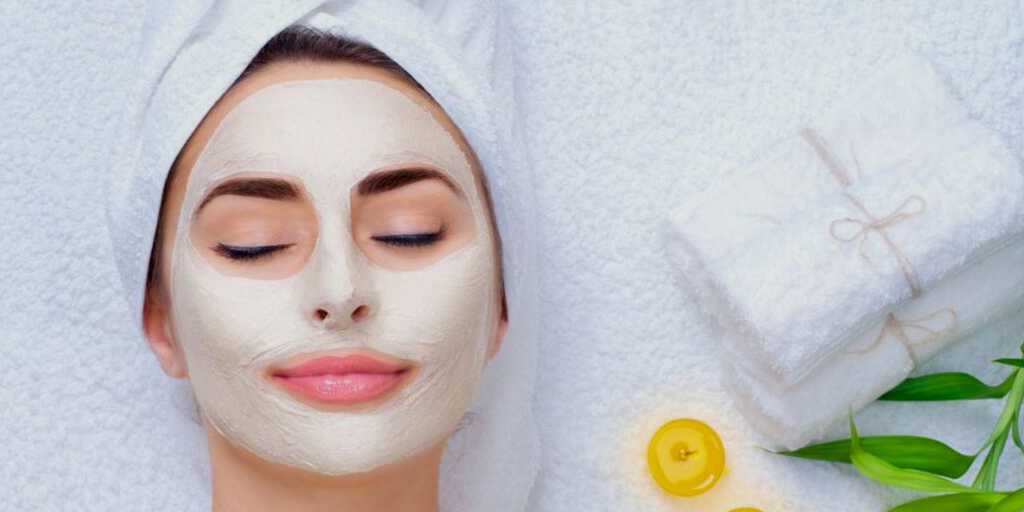
2026 marks the end of the generic “relaxing” facial. Clients now expect measurable results from Medical-Grade Esthetics (MGE), which has made medical spa and aesthetic clinic software one of the fastest-growing categories for salon operators to add.
- Most requested: HydraFacial and Medical-Grade Chemical Peels — see our full breakdown of a hydrating facial treatment for what’s actually involved
- Newest trend: NCTF Skin Revitalization — a micro-injection cocktail of 17 skin-revitalizing ingredients aimed at “glass skin”
- The “Lunchtime Lift”: non-invasive contouring with no downtime, up 22% since 2024
Skincare service demand is expanding quickly as consumers prioritize measurable skin condition improvements, especially anti-aging.
Top requested services:
- HydraFacial Treatments
- Microdermabrasion
- Chemical Peels
- Anti-Aging Facials
- Express Facials
Facial services overall grew 18% in the past year, reflecting sustained consumer demand for ongoing skin maintenance rather than one-off treatments.
| Treatment | Benefit |
|---|---|
| HydraFacial | Deep cleansing & hydration |
| Microdermabrasion | Skin resurfacing |
| Chemical Peel | Skin renewal |
| Anti-Aging Facial | Wrinkle reduction |
| Express Facial | Quick skincare treatment |
III. Nail Care: Artistry Meets Health
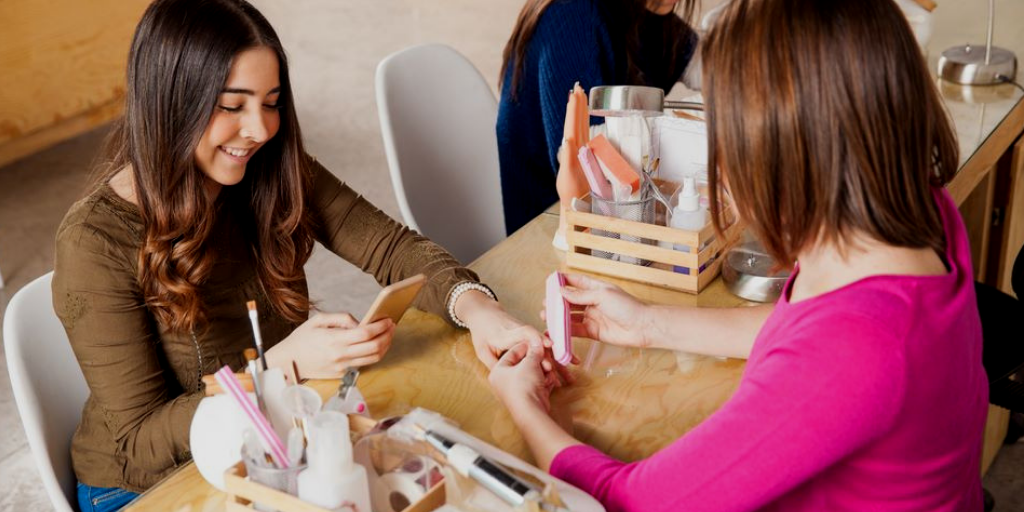
Nail salons have evolved into full “Nail Bars & Lounges,” where high-end nail art has moved from special-occasion spending to bi-weekly maintenance.
- Most booked: Russian manicures and gel extensions
- Growth area: Builder In A Bottle (BIAB) — consumers are shifting away from damaging acrylics toward healthier, strengthening gel alternatives
- Stats: Nail services account for 12% of total salon revenue, with the highest repeat-visit rate of any category (every 14–18 days)
Why nail care dominates bookings:
- Frequent maintenance cycles (2–3 weeks)
- Affordable relative to other beauty services
- High customization (colors, art, extensions)
- Strong social media influence
Globally, gel manicures now account for nearly 58% of all nail salon clients, making them the single most popular nail service. Demand grew 65% between 2019–2022, driven by long-lasting results, chip resistance, high-gloss finish, and fast UV/LED curing.
This aligns with the findings in our related post on nail trends, which breaks down which shapes and finishes are driving current bookings.
| Trend | Impact |
|---|---|
| Builder Gel (BIAB) | Strengthening natural nails |
| Press-on luxury nails | Alternative to salon visits |
| AI nail design | Personalized styles |
| Sustainable nail polish | Eco-conscious beauty |
| Smart nail technology | Color-changing and wearable nails |
The Male Grooming Explosion
Men’s grooming services have become genuinely mainstream in the UAE, with male clients now expecting the same premium experience as their female counterparts — a shift that’s made barbershop-specific software a real operational need rather than a nice-to-have.
The UAE’s total male grooming market is estimated at AED 400 million, growing 25% annually. Services have expanded well beyond haircuts to include:
- Beard shaping
- Facials for men
- Scalp treatments
- Hair colouring
Average spend per male client visit has jumped from AED 120 to AED 340, and beard grooming demand has doubled since 2018 — clear signals of the shift toward premium, specialized services.
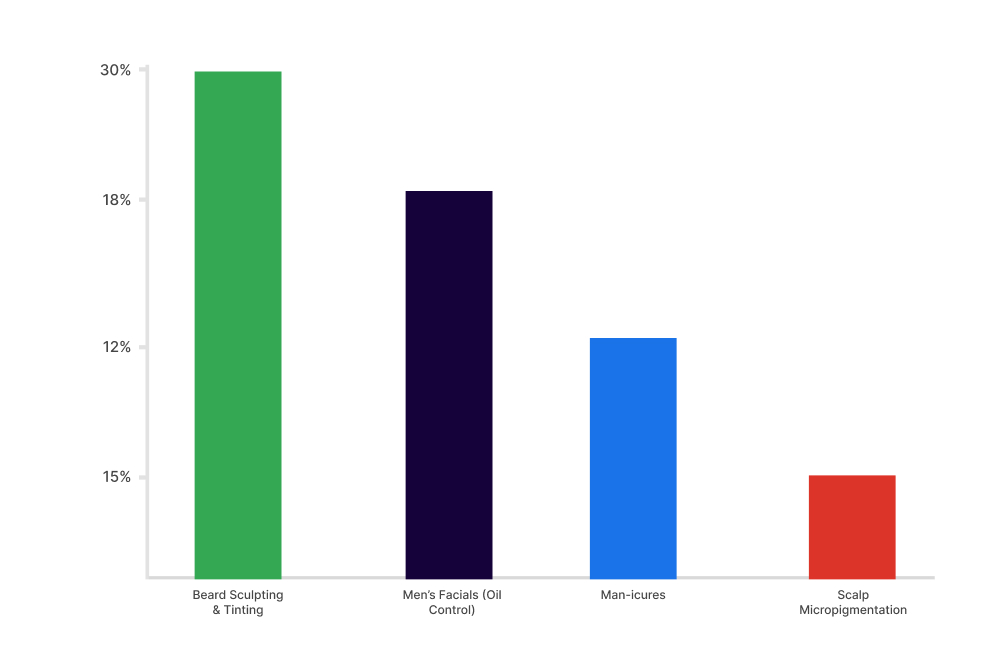
| Service | Growth Rate (YoY) | Description |
|---|---|---|
| Beard Sculpting & Tinting | 30% | Precision shaping using steam and straight razors |
| Men’s Facials (Oil Control) | 18% | Targeting skin issues from gym routines and dust |
| Man-icures | 12% | Clean, buffed nails for professional presentation |
| Scalp Micropigmentation | 15% | Non-surgical solution for thinning hair |
Technology and the “Salon of the Future”
AI and AR have fundamentally changed the booking experience across UAE salons:
- Virtual consultations: 40% of top-tier Dubai salons now offer AI-driven hair color previews in-app before a client ever steps in-store
- Data-driven personalization: Salonist’s platform lets owners track client-level details like ingredient sensitivities automatically, contributing to a 15% increase in customer loyalty scores through better personalized service tracking
Key technology developments:
- AI booking assistants
- Mobile appointment scheduling
- CRM-based personalization
- Automated marketing campaigns
Where the market stands today:
- 72% of salons use digital booking systems
- 82% of bookings happen via mobile
Platforms like Salonist give salons the ability to track client history, deliver personalized recommendations, automate reminders, and measure which services actually retain clients — turning raw booking data into a retention strategy rather than just a calendar.
New & Notable Trends to Watch
Halal-Certified Beauty Products
Demand is rising for Halal-certified, Wudu-friendly beauty products that can be absorbed through water. Salons are increasingly capturing the local Emirati and Muslim resident market by offering Halal-certified nail polish and hair dye.
Eco-Friendly Salons
Environmental awareness has gone mainstream: 35% of customers now specifically seek out “cruelty-free” or “vegan” salon experiences. Many salons have eliminated single-use plastics and adopted eco-friendly fixtures — and these businesses report notably higher engagement from Millennial and Gen Z clients than salons that haven’t made the switch.
The Wellness Merger
The line between salon and wellness center keeps blurring, with salons adding:
- IV drip lounges (vitamin infusion during hair processing)
- Aromatherapy during shampoo services
- Sound healing or meditation tracks in facial treatment rooms
| Trend | Growth Indicator |
|---|---|
| AI Skin Analysis | +340% demand |
| Scalp Health Treatments | +218% demand |
| Organic Beauty Products | Growing |
| Men’s Premium Grooming | Rapid growth |
| Online Booking | Industry standard |
Salon Business Strategy Insights
Turning appointment and booking data into an actual growth strategy comes down to five priorities:
- Focus on demand: hair color, nails, and skincare remain the core revenue drivers
- Invest in skincare: it’s the fastest-growing service category in the market
- Build out male grooming: the segment is growing 25% annually with rising average spend
- Adopt the right technology: digital booking and analytics directly improve client retention
- Personalize everything: tailored service recommendations drive both satisfaction and loyalty
Conclusion
The UAE’s salon market is heading into a period defined by technology, personalization, and premiumization. Hair and nails remain the category staples, but beauty industry trends 2026 point to Male Grooming and Medical Esthetics as the two categories reshaping where new revenue actually comes from.
Key takeaways from Salonist’s 2026 Beauty Trends Report:
- Hair services remain the largest revenue producer
- Nail services are the most frequently booked category
- Skincare is the fastest-growing segment
- Men’s grooming represents the biggest new opportunity
- Personalization and technology are now baseline expectations, not differentiators
With over 15,000 salons competing in Dubai alone, staying ahead means using data-driven salon management systems to keep pace with what UAE consumers expect in 2026.
FAQs: Beauty Industry Trends 2026
What are the current trends in the beauty industry?
The biggest trends right now are Medical-Grade Esthetics replacing generic “relaxing” facials, a boom in men’s grooming services, and AI-driven personalization in booking and service recommendations. Scalp health and skincare have both moved from niche add-ons to core service categories salons actively market. In the UAE specifically, “Precision Pampering” — targeted, machine-supported treatments over generic ones — defines the shift happening across hair, skin, and nail categories. Sustainability and Halal-certified products are also gaining real traction, particularly with younger and regionally rooted clients. Technology adoption, from AI hair-color previews to automated rebooking, is now table stakes rather than a differentiator.
What’s driving the UAE’s beauty industry growth specifically?
Three factors: a large, high-disposable-income, multicultural population that treats grooming as a cultural priority; rapid tourism growth that brings in consistent international clientele; and near-universal smartphone adoption that’s made mobile booking the default channel. Dubai and Abu Dhabi alone account for 70% of the national beauty market share, driven by both resident spending and tourist demand. The market is projected to grow at a 6.14% CAGR through 2034, reaching well beyond its current $3.49 billion valuation. Digital booking platforms have become essential infrastructure rather than a convenience, with roughly 65% of bookings now happening through mobile apps and online platforms.
Which salon services are most booked in the UAE right now?
Hair services lead by revenue, representing about 76% of total salon transactions, with balayage and “liquid hair” glossing the most frequently requested treatments. Nail services generate the highest visit frequency of any category, with clients rebooking every 14–18 days on average. Skincare, particularly HydraFacial and medical-grade chemical peel treatments, is the fastest-growing category as clients move toward measurable, results-driven treatments. Men’s grooming is the newest major growth area, with average spend per visit nearly tripling in recent years. Across all categories, treatments that combine multiple steps into one experience — like scalp therapy paired with a facial — are outperforming single-service bookings.
How is technology changing salon bookings in 2026?
Roughly 72% of UAE salons now use digital booking systems, and over 82% of those bookings happen via mobile devices rather than desktop or phone calls. AI tools are increasingly used for virtual consultations, including hair-color previews that let clients see results before booking. Salon management platforms also track client-specific data like service history and preferences, enabling the kind of personalization that’s driven measurable increases in customer loyalty. Automated reminders and rebooking prompts have become standard tools for reducing no-shows and driving repeat visits. For salon owners, adopting this technology has shifted from an optional upgrade to a baseline requirement for staying competitive.
Is men’s grooming really a growth opportunity for salons in the UAE?
Yes — it’s one of the fastest-growing segments in the entire market, with the UAE’s male grooming sector estimated at AED 400 million and growing roughly 25% per year. Average spend per male client visit has increased from AED 120 to AED 340, showing clients are opting into premium services rather than basic haircuts. Beard grooming demand alone has doubled since 2018, and services like scalp micropigmentation and precision beard sculpting are seeing double-digit annual growth. Salons that have built out dedicated men’s grooming menus and marketing are capturing disproportionate share of this growth compared to those treating it as an afterthought. For salons not yet offering specialized men’s services, this is currently the clearest under-served opportunity in the UAE market.
What should salon owners prioritize based on these 2026 trends?
Five things matter most: keeping core revenue drivers (hair, nails, skincare) fully optimized, investing further in skincare since it’s growing fastest, building out a dedicated men’s grooming offering, adopting booking and analytics technology, and personalizing service recommendations using client history. Owners who track appointment data closely can identify which specific services are actually driving repeat visits versus one-off bookings, and adjust pricing or marketing accordingly. Technology adoption isn’t optional anymore — salons without digital booking are already at a competitive disadvantage given that most bookings now happen via mobile apps. Personalization, from remembering client preferences to tailored service suggestions, is what’s driving the loyalty score improvements salons are reporting. The salons winning the most bookings in this market are the ones treating data as a strategy tool, not just a scheduling convenience.
Summer heat, sun exposure, and chlorine or salt water strip moisture from your skin and hair faster than any other Read more
If you don’t have your business accounts on social media sites yet, you are living under a cave. The greatest Read more
Owning a salon is bliss, and not everyone gets to enjoy it. However, some things might get you worried, like Read more
Going to the beauty salon for a relaxing facial has its own perks, but not everybody has the time or Read more